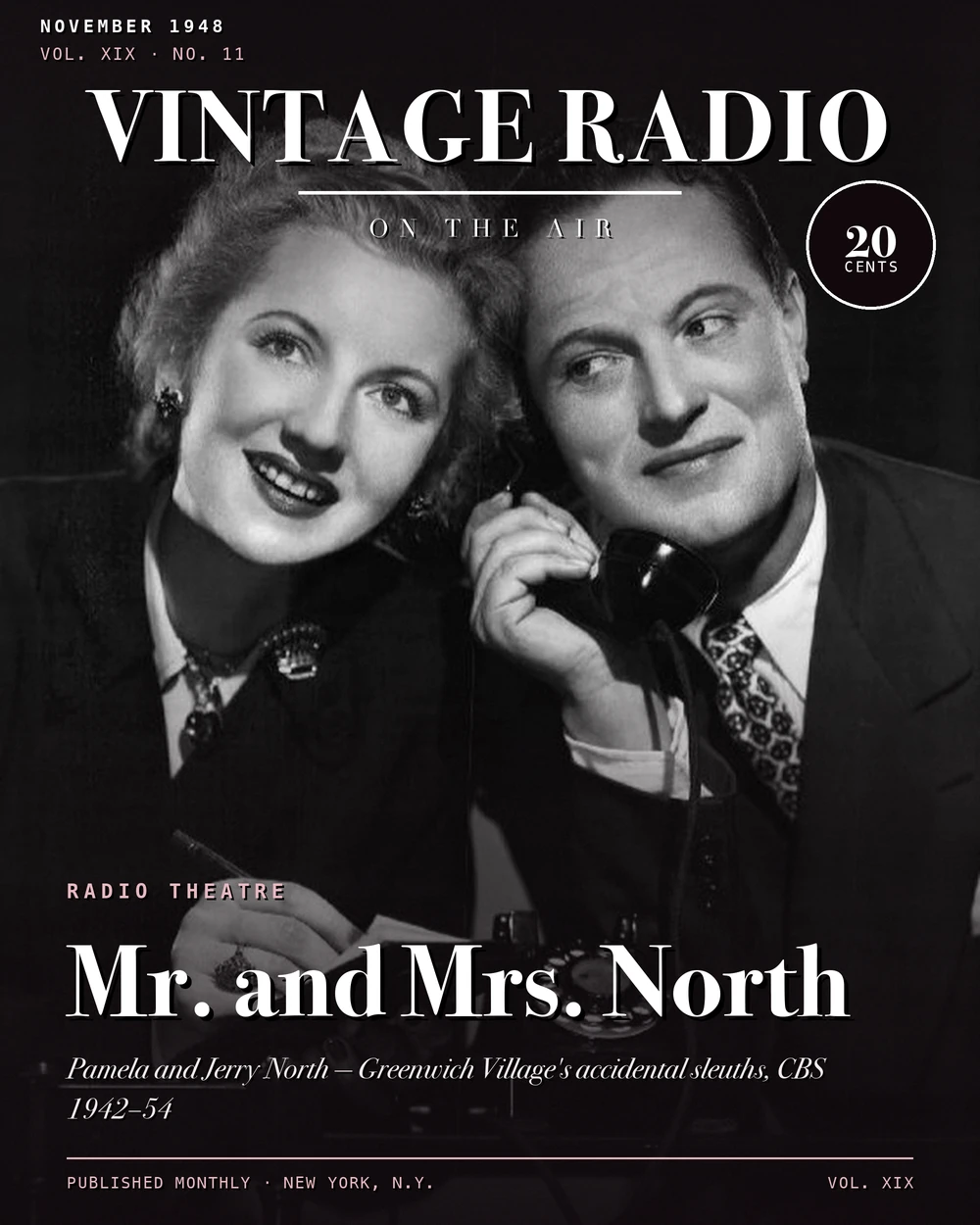
Mr. and Mrs. North
How a Domestic Comedy Became a Murder Magnet
The Norths didn't set out to solve murders. Jerry North was a book publisher, Pam was his quick-witted wife, and the two of them lived in a Greenwich Village apartment at 24 St. Anne's Flat — perfectly ordinary people who somehow kept tripping over corpses. That was the premise, and it worked. Mr. and Mrs. North was the most successful husband-and-wife crimefighting series of its day, drawing an audience of 20 million listeners a week in its second year on the air.
The show had a longer road to radio than most listeners knew. An audition recording was made in 1941, written by Howard Harris and Martin Gosch and featuring Peggy Conklin as Pam and Carl Eastman as Jerry. That version played up the light romance angle and didn't get picked up. When the mystery version finally launched on NBC on December 30, 1942, it came out of the gate strong — immediately challenging Mr. District Attorney for the top spot in the mystery ratings. The second take worked where the first had not, and the Norths were on the air for more than a dozen years.
The Lockridges
The source material came from Frances and Richard Lockridge, a husband-and-wife writing team whose paths to fiction ran through Kansas City newsrooms. Richard, born in St. Joseph, Missouri in 1898, had reported for the Kansas City Kansan and the Kansas City Star before becoming a drama critic for the New York Sun. Frances, born in Kansas City in 1896 and educated at the University of Kansas, had worked as a reporter and music critic for the Kansas City Journal-Post and the Star. They married in March 1922. Richard later described his wife as the plot generator: "we had story conferences, and wrote a summary… the writing was entirely mine."
Richard had originally written the North characters as light domestic misadventures for The New Yorker in the 1930s. In 1937 Frances came up with the plot for a detective novel but got stuck on a complication, called Richard in to help, and the writing team was formally launched. The Norths Meet Murder followed in 1940, and the Norths shifted permanently into murder mysteries. The pair eventually produced 26 Mr. and Mrs. North novels and spun off a 22-novel series featuring Lt. Merton Heimrich. Richard won an Edgar Award in 1945 for best radio play; in 1960 the couple served as co-presidents of the Mystery Writers of America, and in 1962 they shared a special Edgar. The Mr. and Mrs. North run ended only when Frances died on February 17, 1963; Richard wrote no more North novels after that, though he continued other detective work until his own death in 1982.
Broadway and Hollywood First
Radio wasn't the Norths' first public stage. Owen Davis adapted the Lockridge material into a Broadway play that opened at the Belasco Theatre on January 12, 1941, produced and directed by Alfred De Liagre, Jr., and ran for 163 performances through the end of May. Albert Hackett played Jerry, Peggy Conklin played Pamela, and Philip Ober portrayed Lieutenant Weigand. Brooks Atkinson in the New York Times commended the leads for delivering "odd, bright lines" amid the chaos of the murder investigation and noted that the humor arose from treating crime as a routine social inconvenience.
MGM brought the property to the screen the following year. Robert B. Sinclair directed the 1942 film, with Gracie Allen as Pam — her first screen role since The Gracie Allen Murder Case in 1939 — and William Post, Jr. as Jerry. Millard Mitchell reprised his stage role as Detective Mullins; Paul Kelly, Rose Hobart, and Keye Luke rounded out the cast. The New York Times was unimpressed, suggesting that "folks who are seeking entertainment with a bit of body to it may find this film rather thin pickings." By the time radio audiences met the Norths in late 1942, in other words, the characters were already a known cultural quantity — which helps explain why the NBC launch came out of the gate so fast.
The Way the Show Actually Worked
What separated Mr. and Mrs. North from other mystery programs was the insistence on keeping everything recognizable. The murders were ordinary ones — stabbings, shootings, crimes of passion. Producer S. James Andrews once rejected a script because it was set in a medieval museum and involved ancient torture devices. The reasoning was direct: if it wasn't familiar to the common man, it didn't belong in the show. That philosophy kept the Norths grounded in a world that felt like it could be next door.
Jerry and Pam weren't trained detectives and weren't pretending to be. Jerry stumbled over a body each week through purely accidental circumstances — a wrong turn, a coincidence, an ordinary errand gone sideways. Pam, for her part, arrived at the killer's identity through what the show called female intuition. She'd reach a conclusion first and then work backward to find supporting facts. Jerry explained the difference himself in a 1943 issue of Radio Mirror: men think logically from cause to effect, while Pam reaches a conclusion first and then gathers the facts to back it up. It was a neat inversion of the standard detective formula and gave Pam a voice that felt distinct from the usual sharp-tongued sidekick.
Pam had a full personality beyond the mystery plots. She loved cats, liked to play matchmaker for her single friends, and had a roundabout way of talking that could drive Jerry to distraction. One of her ongoing projects was trying to get Lt. Bill Weigand married off — a scheme that never once succeeded across more than a decade of episodes.
The Cast Through the Years
Joseph Curtin played Jerry North and Alice Frost played Pam for the NBC years and into the early CBS run. When the show transitioned into its long CBS tenure, Richard Denning eventually took over as Jerry and Barbara Britton as Pam. Both pairings carried the characters' essential dynamic, which the scripts kept consistent regardless of who was doing the playing.
The supporting cast gave the show much of its texture. Frank Lovejoy originated the role of Lt. Bill Weigand of homicide, the Norths' best friend and the professional lawman who cleaned up after their amateur investigations. Staats Cotsworth and Francis DeSales each played Weigand at different points. Walter Kinsella played Sgt. Aloysius Mullins — father of eight children, perpetually exasperated, and usually the one left standing at the scene when the Norths had wandered off in the wrong direction. Betty Jane Tyler played Susan, the Norths' teenage niece, described as something of a problem child who occasionally stumbled over her own bodies. Mandel Kramer played Mahatma McGloin, a talkative cab driver who circulated through the Norths' acquaintance circle along with underworld floaters and neighborhood tip sellers. Charles Paul led the orchestra, and the show's theme was "The Way You Look Tonight."
Twelve Years Across Two Networks
The NBC run lasted from December 30, 1942 to December 18, 1946, airing Wednesdays at 8 and sponsored by Jergens Lotion and Woodbury Cold Cream. CBS picked the show up on July 1, 1947, where it ran Tuesdays at 8:30 with Colgate-Palmolive — sponsoring various products including Halo Shampoo — as the main backer through 1954. S. James Andrews and John W. Loveton produced, with Sam Monroe handling sound on NBC and Al Binnie and Al Hogan taking over for the CBS run.
In the fall of 1954, the show tried something different, briefly shifting to a 15-minute serial format airing on weekdays from October 4 to November 19. It didn't stick. By November 29, 1954, the Norths were back in their familiar 30-minute format, this time on Monday evenings. The final broadcast came on April 18, 1955.
Of a run that almost certainly exceeded 500 episodes — broadcast logs reach at least episode 509 — only about 80 broadcasts are known to survive. A certified accurate collection of the available episodes was assembled in April 2013 and issued as a three-CD set. Joe Hehn, who lived from 1931 to 2020, was a pioneering collector whose reel tapes and discs, digitized by volunteers including the "Knights of the Turning Table," account for much of what listeners can still hear today. The earliest surviving Curtin-and-Frost broadcast is "Russian Restaurant Murder," episode six, from February 3, 1943.
The Television Years
The Norths jumped to television almost as soon as the medium could carry them. Producer-director Fred Coe staged the Owen Davis play on New York's WNBT in 1946, with John McQuade and Maxine Stuart in the title roles. A second attempt came on July 4, 1949, when Colgate Theatre on NBC aired a pilot starring Joseph Allen Jr. and Mary Lou Taylor, produced by John Loveton, directed by Marc Daniels, and scripted by Hector Chevigny.
The regular television series finally arrived in October 1952, running on CBS through September 1953 and then jumping to NBC from January through July 1954 — 57 episodes in all, 39 in the first season and 18 in the second, with Richard Denning and Barbara Britton in the leads and Francis DeSales playing Weigand for 25 of those installments. It was a punishing schedule: few rehearsals, most scenes shot in one take, each episode completed in three days. The radio production relocated from New York to Hollywood in 1953 to accommodate Denning and Britton's television commitments, which is how the radio show ended up with two of its stars also carrying a weekly TV series.
Critics responded well. John Lester of the Sunday Star-Ledger wrote that the Norths on television "are always pleasant and likeable young people, frequently even delightful" — viewers, he thought, could see themselves in them. TV Guide judged that a mid-run format revision "improved the show considerably," noting that more focus on mystery and less on farce produced "a more entertaining and suspenseful half hour." Reruns were initially handled by Advertisers' TV Program Services, a syndication company John Loveton created specifically for that purpose. Sixteen episodes have since been collected in the "Best of TV Detectives" box set.
What the Norths Left Behind
The husband-and-wife amateur-sleuth premise didn't end with the Norths, and the comparisons followed for decades. Radio historian Jim Cox, in Radio Crime Fighters, captured the appeal as well as anyone: the Norths "who passed themselves off as a publisher and his homemaker-spouse continued to make lighthearted wisecracks as they stepped over bodies in dark alleys… The feminine half of the twosome was at least equal to the husband in solving cases that often baffled law-enforcement officers." Ernie Kovacs and Edie Adams paid the show the compliment of parody, mounting sketches called Mr. & Mrs. South on Kovacs's morning comedy program Three to Get Ready at WPTZ-TV in Philadelphia. Decades later, ABC's Hart to Hart — Robert Wagner and Stefanie Powers as wealthy amateur sleuths from 1979 to 1984 — was described by OTR archivists as a spiritual successor that "played the crime theme with wry wit reminiscent of the Norths in their heyday." Two ordinary people, one Greenwich Village apartment, and a murder a week: the formula proved sturdier than the broadcasts themselves.